
Sunlight basics
The five ideas you need to interpret a sun map without relying on misleading compass shortcuts.
Last reviewed September 18, 2026Direction is only the beginning
“South-facing is sunny” is a Northern Hemisphere rule of thumb, not a universal result. Latitude, season, window height and nearby obstructions can reverse the practical outcome. Near the tropics, the midday sun can pass on different sides of a building during the year.
Azimuth tells you where to look
Solar azimuth is the compass bearing toward the sun. SunCarta measures it clockwise from true north: 90° is east, 180° south and 270° west. Compare it with the direction a window, facade or camera faces.
A difference below 90° places the sun broadly in front of that plane. A difference near 90° creates side light. A larger difference places the sun behind it.
Altitude controls shadow length
Solar altitude is the angle above the horizon. When the angle is low, a modest wall can cast a long shadow. As altitude rises, the same wall’s shadow contracts. That is why winter and late-afternoon tests matter even when a place looks clear at summer noon.
Direct sun is not the same as daylight
Direct sun is a beam with a clear geometric path. Daylight also includes the bright sky and light reflected by walls, ground and neighboring buildings. A room can have zero direct sun and still be comfortable and bright; conversely, a short direct beam can cause glare without illuminating the whole room.
Use representative dates
For a first comparison, test a date near each solstice and equinox. Then test the actual season that matters: the growing months for a garden, the listing period for an apartment, or the scheduled date and hours for an event.
- Use the same dates and assumptions when comparing alternatives.
- Measure the obstacle most likely to change the decision.
- Test plausible low and high dimensions when a height is uncertain.
- Visit the place at a relevant time before a consequential purchase when possible.
Three field notes to keep
Original SunCarta diagrams for reading a sun map, checking a shadow and understanding local obstruction. Download the SVGs for a sharp print at any size.
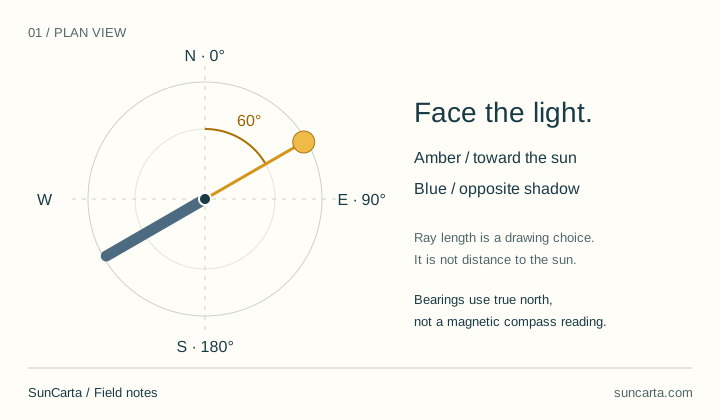
01 / Direction is a bearing, not a distance
Read azimuth clockwise from true north. The amber ray points toward the sun; its drawn length is only a visual aid. A vertical object casts its ground shadow in the opposite direction.
Download diagram · SVG ↓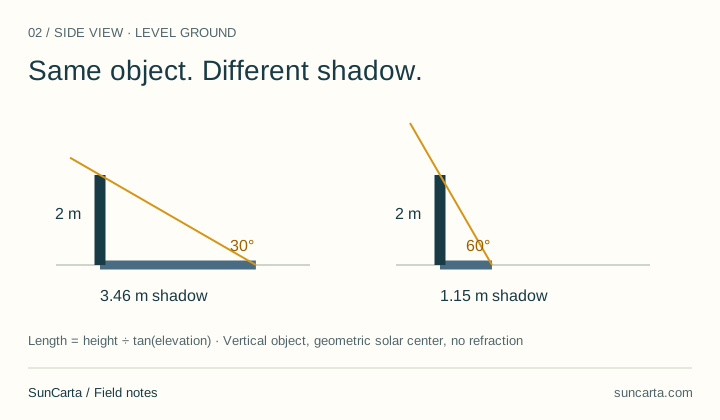
02 / A lower sun makes a longer shadow
For a vertical object on level ground, length = height ÷ tan(solar elevation). A 2 m object casts about 3.46 m at 30°, or 1.15 m at 60°. Slopes, uneven ground and overlapping objects require more context.
Download diagram · SVG ↓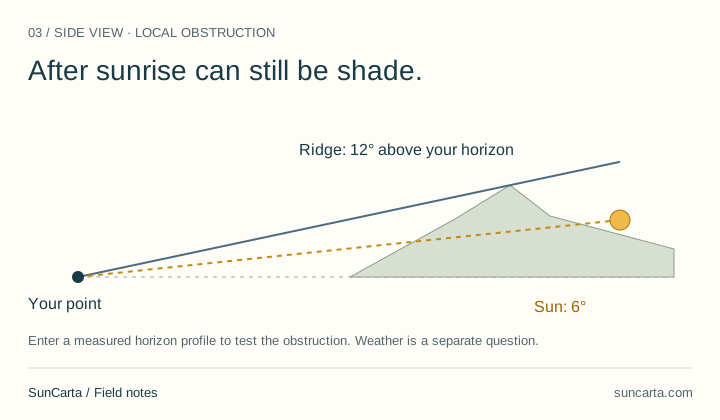
03 / Sunrise is not your first direct sunlight
An open-horizon sunrise does not guarantee sunlight at your pin. If a ridge or building rises 12° above your horizon, a sun at 6° is still hidden. Add measurements to test local obstruction; map imagery alone cannot tell you this.
Download diagram · SVG ↓Put the geometry on the map
Choose an exact point, orient the space and add the objects that block its sky.
Open the SunCarta simulator →